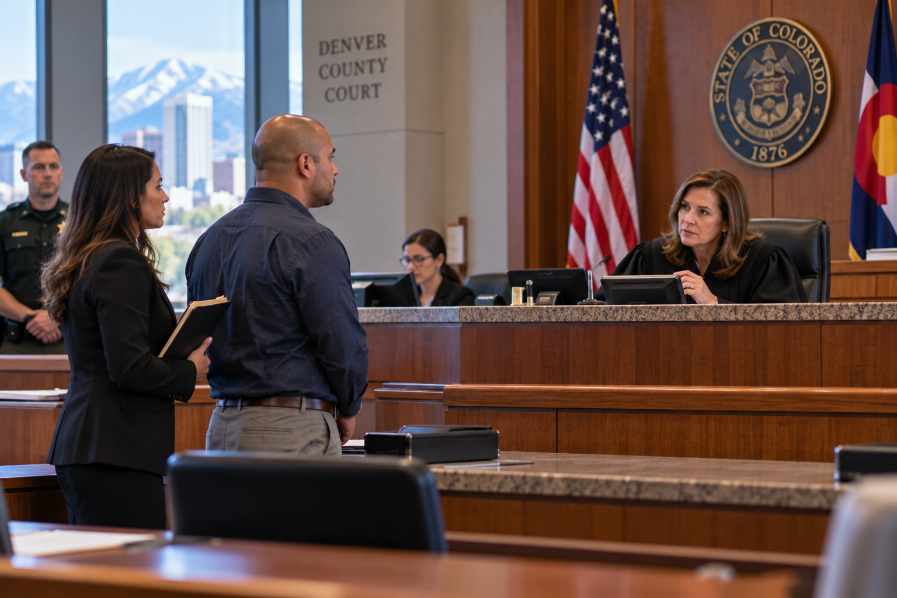
What Happens at Your First Court Appearance in Denver County?
Quick Answer: What Happens at Your First Court Appearance in Denver County?
Your first court appearance in a Denver criminal case depends on the type of case and whether you are in or out of custody.
At an initial appearance or advisement, the court generally advises you of the charges and important constitutional rights. If bond or release conditions need to be addressed, the court may also consider those issues.
You do not necessarily enter a plea at your first appearance. Arraignment—the stage at which a plea is entered—is a separate procedural event, although the timing and sequence of hearings depend on the case.
For Denver County Court criminal and municipal matters, proceedings are generally handled at the Lindsey-Flanigan Courthouse at 520 West Colfax Avenue. Always check your summons, bond paperwork, or current court schedule because your specific appearance instructions control.
Key Takeaways for Your First Court Appearance in Denver
- Your first appearance may involve an advisement of the charges and your rights.
- A first appearance and an arraignment are not necessarily the same thing.
- You may not be required to enter a plea at your first appearance.
- Bond and release conditions may be addressed depending on your custody status and procedural posture.
- Denver County Court's criminal and municipal divisions operate at the Lindsey-Flanigan Courthouse.
- Felony cases can begin with proceedings in county court before moving to Denver District Court.
- Missing a required court appearance can lead to serious consequences, potentially including a warrant.
- Your paperwork and current court docket are the best sources for determining where, when, and how you must appear.
What Is a First Appearance in Colorado?
A first appearance is an early stage of the criminal process in which a defendant appears before the court and receives important information about the case and their rights.
Colorado Rule of Criminal Procedure 5 governs preliminary proceedings in state criminal cases.
At the first appearance, Rule 5 requires the court to advise the defendant of specified rights and information.
Depending on the case, those can include:
- The nature of the charges;
- The right to remain silent;
- The fact that statements can potentially be used against the defendant;
- The right to an attorney;
- The right to request appointed counsel if eligible;
- The right to bail when the offense is bailable;
- The right to a jury trial; and
- In qualifying felony cases, rights concerning a preliminary hearing.
The exact advisement depends partly on whether the case is a felony or misdemeanor and its procedural posture.
Is a First Appearance the Same as an Arraignment?
Not necessarily.
This is one of the most important corrections to make when explaining the Colorado court process.
A first appearance or advisement is an early proceeding at which the court provides required information concerning the charges and the defendant's rights.
An arraignment is the procedural stage associated with entering a plea.
Those events can occur at different times.
So you should not assume that simply because you are going to court for the first time, you will be required to plead guilty or not guilty that day.
Where Do Denver Criminal Court Appearances Take Place?
Denver's court structure can be confusing because different divisions operate in different downtown buildings.
Lindsey-Flanigan Courthouse
520 West Colfax Avenue
Denver, Colorado 80204
Denver County Court identifies Lindsey-Flanigan as the location of its Criminal and Municipal Divisions.
That includes Denver County Court matters involving state criminal offenses as well as cases involving Denver municipal ordinances.
City & County Building
1437 Bannock Street
Denver, Colorado 80202
Denver County Court identifies the City & County Building as the location of its Traffic and Civil Divisions.
So someone facing a criminal charge should not assume that a Denver court appearance takes place at the City & County Building simply because it is one of Denver's most recognizable courthouse buildings.
Always Check Your Paperwork
Courtrooms and appearance requirements can change.
Before going to court, check:
- Your summons;
- Bond paperwork;
- Court notices;
- Your case information; and
- The current Denver County Court schedule.
Denver County Court also provides a public case-management portal that can be used to locate current case and court-date information.
What Actually Happens at Your First Appearance?
There is no single sequence that applies identically to every defendant.
Someone appearing after receiving a summons may have a different experience from someone who was arrested and remains in custody.
A misdemeanor case can also proceed differently from a felony case.
But an early criminal appearance may involve several of the following steps.
1. Finding Your Courtroom
When you arrive, you will go through courthouse security and locate the courtroom listed for your case.
Arrive with enough time to get through security and find the correct room.
Denver County Court's public portal can also provide courtroom information for scheduled cases.
2. Waiting for Your Case to Be Called
Criminal courtrooms often handle numerous cases during the same session.
Your actual interaction with the judge may be relatively short even though you spend considerably longer at the courthouse waiting for your case.
3. Advisement of Charges and Rights
At an initial advisement, the court may explain the charges and advise you of applicable rights.
This is an important distinction from deciding whether the prosecution can ultimately prove those charges.
An advisement tells you what has been alleged and explains procedural rights. It is not a determination of guilt.
4. Counsel Issues
The court may address whether you have an attorney.
If you cannot afford private counsel and meet the applicable requirements, you may be able to seek representation through the Colorado State Public Defender.
Do not assume that the judge or prosecutor can give you legal advice if you are unrepresented. Their roles are different from the role of defense counsel.
5. Bond or Release Conditions
Depending on the case, the court may address bond, custody status, or conditions of release.
Some defendants will already have been released before their first scheduled court appearance. Others may be appearing from custody.
The court can impose or modify legally authorized release conditions depending on the circumstances.
6. Setting the Next Court Date
If the case is not resolved, the court will generally determine what happens next.
That could include another advisement, arraignment, pretrial conference, preliminary hearing, motions hearing, or another proceeding depending on the type and stage of the case.
Make sure you know:
- The next date;
- The time;
- The courtroom;
- Whether you must personally appear; and
- Any conditions you must follow before then.
Do You Plead Guilty or Not Guilty at Your First Court Appearance?
Not necessarily.
The original draft correctly distinguishes an advisement from arraignment, but it then suggests that entering a not-guilty plea is a routine component of the first appearance.
That can create the wrong expectation.
A plea is associated with arraignment, and arraignment may occur at a different point in the case.
If and when you are arraigned, Colorado criminal procedure recognizes pleas including:
- Guilty;
- Not guilty;
- Nolo contendere, or no contest, with the court's consent; and
- Not guilty by reason of insanity when legally applicable.
A defendant should understand the legal consequences before entering a guilty or no-contest plea.
You do not need to assume that you must decide the entire case simply because you are appearing in court for the first time.
What Is Bond in a Colorado Criminal Case?
Bond concerns the conditions under which a defendant may remain out of custody while a criminal case is pending.
Colorado law generally requires courts to consider appropriate release conditions based on the individual circumstances and applicable statutes.
Depending on the case, release can involve monetary or nonmonetary conditions.
Conditions can address matters such as:
- Appearing for future court dates;
- Contact with specified people;
- Possession of weapons;
- Alcohol or controlled-substance use;
- Monitoring;
- Travel; or
- Other conduct relevant to the case and authorized by law.
Not every defendant receives the same conditions.
What Is a Personal Recognizance Bond?
A personal recognizance, or PR, bond generally permits release without requiring the defendant to post the monetary amount of the bond in advance.
That does not mean the defendant has no obligations.
The person must still comply with the conditions of release and appear when required.
Can the Judge Change Your Bond?
Colorado law permits courts to modify bond conditions under specified circumstances.
That can include changes to financial conditions or other terms of release.
A defense attorney can seek modification when appropriate, and the prosecution can also request changes.
What About Protection Orders?
Criminal cases can involve protection orders in addition to ordinary bond conditions.
Colorado law provides for mandatory criminal protection orders in criminal cases, although the restrictions imposed depend on the case and the court's order.
A protection order may restrict contact with an alleged victim or witness or impose other conditions.
Read the actual written order carefully.
Do not assume you may contact someone simply because that person contacts you first or says they want to communicate.
If a court order prohibits the contact, the order controls until it is modified or terminated by the court.
Do You Need a Lawyer at Your First Appearance?
You are not necessarily required to hire a private criminal defense attorney before appearing in court.
But you have a constitutional right to counsel in criminal proceedings in circumstances where that right applies, and Colorado's Rule 5 advisement specifically addresses the right to counsel.
If you qualify financially and otherwise meet the requirements for appointed representation, you may be eligible for the Colorado State Public Defender.
If you intend to hire private counsel, speaking with an attorney before an early appearance can help you understand:
- What you are charged with;
- Whether bond needs to be addressed;
- Whether a protection order applies;
- Whether you should make any statements;
- What deadlines may be approaching;
- What evidence should be preserved; and
- What the next stage of the case is likely to involve.
A lawyer cannot guarantee a particular result, but counsel can help you avoid making decisions without understanding their consequences.
What Should You Wear to Court?
You do not need an expensive suit to appear in Denver County Court.
Clean, neat, courtroom-appropriate clothing is generally sufficient.
Avoid clothing with offensive language or images and anything that may unnecessarily distract from the proceeding.
More important than dressing formally is behaving appropriately in court.
That generally means:
- Arriving on time;
- Following security procedures;
- Silencing your phone;
- Listening carefully;
- Avoiding interruptions;
- Addressing the judge respectfully; and
- Following instructions from court staff and your attorney.
What Happens if You Miss Your Denver Court Date?
Missing a required court appearance can have serious consequences.
Depending on the type of case and circumstances, the court may issue a warrant or take other action.
There may also be consequences involving bond.
But it is too broad to say that every missed appearance automatically results in a new criminal charge.
The legal consequences depend on the case, why the defendant was required to appear, the applicable statutes, and what the court orders.
If you have already missed a court date, address the situation promptly.
A lawyer may be able to determine:
- Whether a warrant was issued;
- What type of warrant it is;
- Whether the court will consider recalling or quashing it;
- Whether a new appearance can be scheduled; and
- What other steps are required.
Do not simply assume that the problem will disappear on its own.
Denver County Court vs. Denver District Court
Denver's criminal court system can be confusing because felony cases can involve both county and district court.
Denver County Court
Denver County Court's Criminal Division handles a range of state criminal matters, including misdemeanors and petty offenses.
It also handles preliminary stages of felony cases, including certain felony advisements, bond matters, and preliminary hearings.
Denver Municipal Cases
Denver County Court's Criminal Division also includes municipal courtrooms that handle alleged violations of Denver ordinances.
Municipal cases are governed by Denver's municipal code and procedures rather than simply being interchangeable with state misdemeanor cases.
Denver District Court
Felony prosecutions that proceed beyond the preliminary county-court stages are generally handled in Denver District Court.
So a person charged with a felony may first appear in Denver County Court even though the felony case ultimately proceeds in district court.
What Happens in a Felony Case After the First Appearance?
A felony case can involve additional preliminary proceedings before the case reaches the stage most people associate with felony prosecution in district court.
Depending on the charge and circumstances, those proceedings can include:
- Advisement;
- Bond proceedings;
- Appointment or retention of counsel;
- A preliminary hearing when legally available;
- Filing of charging documents;
- Transfer or bind-over to district court; and
- Arraignment in district court.
The sequence depends on how the case was initiated and the particular charges.
This is another reason not to describe every first appearance as an arraignment.
What Comes After Arraignment?
Once a defendant has entered a not-guilty plea at arraignment, the case generally proceeds through the pretrial process.
That may include:
Discovery
The defense obtains and reviews evidence disclosed by the prosecution.
Depending on the case, discovery can include police reports, video, photographs, witness statements, recordings, laboratory evidence, and other material.
Investigation
The defense may conduct its own investigation, locate witnesses, preserve evidence, and examine weaknesses or inconsistencies in the government's case.
Motions
Attorneys can file appropriate motions addressing evidentiary, constitutional, procedural, or other legal issues.
Negotiations
The prosecution and defense may discuss potential resolutions.
A plea agreement is not required, and the defendant generally decides whether to accept or reject an offer after receiving legal advice.
Trial
If the case is not dismissed or otherwise resolved, it may proceed to trial.
How Do You Find Your Denver Court Date?
Denver County Court provides an online Public Portal for case information.
The portal allows users to search for an upcoming court date using identifying information and also provides case searches using a valid case number or arrest-booking number.
Your court paperwork remains important because it contains information specific to your case.
If there is any conflict or uncertainty, confirm the correct appearance requirements with the court or your attorney before the scheduled date.
Can You Appear Virtually?
Sometimes, but do not assume that a virtual option is available.
Denver County Court maintains virtual-court resources, but whether remote participation is permitted depends on the courtroom, proceeding, current court policies, and orders in the individual case.
Your court notice and the judge's instructions control.
If your paperwork says to appear in person, do not switch to virtual attendance without confirming that the court permits it.
FAQ: First Court Appearance in Denver County
How Long Does a First Court Appearance Take?
The actual hearing may be brief, but the total amount of time you spend at the courthouse can be much longer.
Criminal courtrooms often handle numerous cases on the same docket, so you may need to wait before your case is called.
Can I Reschedule My Denver Court Date?
You can request a continuance or other change, but you should not assume that simply requesting a different date excuses you from appearing.
The court must approve the change.
Unless the court or your attorney confirms that your appearance has been changed or excused, follow the existing court order or notice.
Do I Have to Appear in Person?
It depends on your case and the court's instructions.
Denver County Court provides virtual-court resources for certain proceedings, but remote participation is not automatically available for every hearing.
Check your paperwork and current case information or confirm with the court or your attorney.
Do I Plead Guilty or Not Guilty at My First Appearance?
Not necessarily.
Your first appearance may be an advisement rather than an arraignment.
A plea is entered at arraignment, which may occur at the same stage in some cases but can also take place later.
Do not assume you must make a final plea decision merely because it is your first time appearing in court.
What Happens if I Plead Guilty?
A guilty plea generally waives important constitutional rights and can result in a criminal conviction.
Before accepting a guilty plea, the court must satisfy legal requirements intended to ensure that the plea is voluntary and that the defendant understands the relevant rights and consequences.
Because of those consequences, it is important to understand the charge and proposed disposition before pleading guilty.
Can Charges Be Dismissed at an Early Court Appearance?
Potentially.
Charges can be dismissed at different stages of a criminal case when the prosecution seeks dismissal or when another legal basis authorizes the court to dismiss them.
But dismissal is not a routine feature of a first appearance.
Whether it is possible depends on the facts, evidence, law, and procedural posture of the case.
Will I Go to Jail at My First Court Appearance?
It depends.
A person who appears from custody is in a different position from someone who was already released on bond or received a summons.
The court may address bond or release conditions when legally appropriate.
Whether someone remains in custody depends on the charges, existing bond, eligibility for release, applicable statutes, and the judge's orders.
Can I Bring Someone With Me?
Court proceedings are generally open to the public, subject to applicable courtroom rules, security requirements, capacity limits, confidentiality requirements, and orders entered in particular proceedings.
Someone accompanying you should be prepared to follow courthouse security and courtroom instructions.
How Do I Find Out What I'm Charged With?
Your charging documents and court paperwork should identify the charges against you.
The court also advises defendants concerning the nature of the charges as required during applicable preliminary proceedings.
Denver County Court's Public Portal provides case information and court-date searches. For a case search, the portal indicates that a valid case number or arrest-booking number can be used.
Facing Your First Court Appearance in Denver?
Your first court date can feel intimidating, but understanding what the hearing actually is—and what it is not—can make the process more manageable.
You may not be expected to resolve the entire case that day.
The important things are knowing what you are charged with, understanding the conditions you must follow, protecting your rights, and knowing what happens next.
Price Criminal Defense represents people facing criminal charges in Denver and throughout Colorado.
Call
Price Criminal Defense at
(720) 615-7106 for a
free consultation. All calls are answered 24/7. We represent clients in
Denver and throughout the surrounding area.