What Happens to Your Driver’s License After a DUI Arrest?
Quick Answer: What Happens to Your License After a DUI in Colorado?
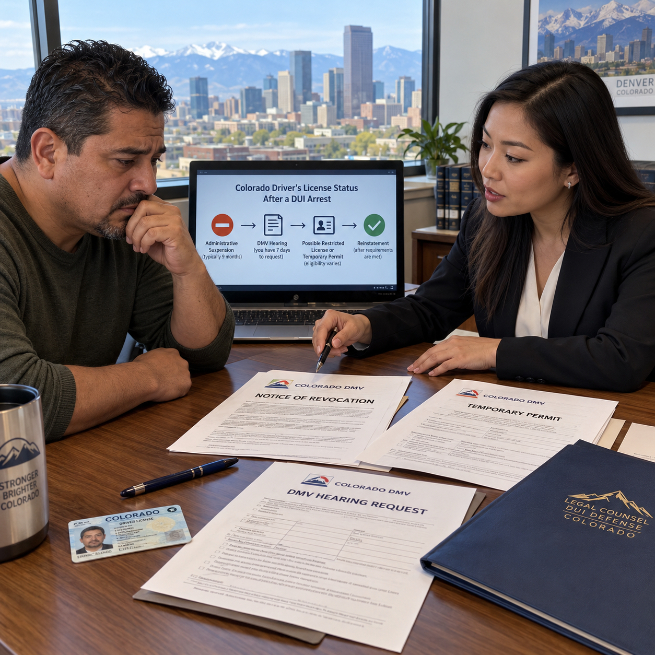
A Colorado DUI arrest can trigger a driver's-license proceeding through the Colorado Division of Motor Vehicles that is separate from the criminal case.
For a first alcohol-related DUI per se revocation involving a BAC of 0.08 or higher, the revocation period is generally nine months. A first refusal of a lawfully requested chemical test generally results in a one-year revocation and additional reinstatement requirements.
But one of the most important things to understand is that not every DUI case has the same seven-day DMV deadline.
If your license was surrendered at the time of the stop in an express-consent proceeding, Colorado DMV generally gives you seven days to request a hearing. In a blood-test case where you retain your license while results are pending, DMV generally sends a later notice containing a response date by which you must request the hearing.
Check the notice you actually received immediately.
Key Takeaways About Your License After a Colorado DUI
- The DMV proceeding is separate from the criminal DUI case.
- A first DUI per se revocation involving BAC of 0.08 or higher generally lasts nine months.
- A first chemical-test refusal generally results in a one-year revocation.
- The seven-day hearing deadline does not apply identically to every DUI case.
- Blood-test cases generally involve a later DMV notice with its own response deadline.
- Refusing a chemical test can result in additional consequences, including Persistent Drunk Driver requirements.
- Eligible drivers may be able to obtain early reinstatement with an ignition interlock-restricted license.
- Dismissal or acquittal in the criminal case does not automatically eliminate a separate DMV revocation.
DUI Arrests Can Create Two Separate Cases
A Colorado DUI can create two proceedings at the same time.
The Criminal Case
The criminal case takes place in court.
It determines whether the prosecution can prove offenses such as:
- DUI;
- DUI per se;
- DWAI; or
- Other related criminal or traffic offenses.
Possible consequences can include jail, fines, probation, useful public service, alcohol treatment, and a criminal conviction.
The DMV Case
The Colorado DMV handles the administrative consequences involving your driving privilege.
The DMV can impose a revocation based on Colorado's express-consent and DUI per se laws even while the criminal case is still pending.
That means a person can potentially prevail in one proceeding without automatically prevailing in the other.
A dismissal of the criminal DUI charge, for example, does not by itself erase an administrative revocation already imposed by the DMV.
How Long Do You Have to Request a Colorado DMV Hearing?
This is where many explanations of Colorado DUI law become too simplistic.
You will frequently hear that you have seven days after a DUI arrest to request a DMV hearing.
That is not accurate in every case.
If Your License Was Surrendered at the Stop
Colorado DMV's express-consent process provides that when the driver's license is surrendered at the time of the stop, the driver generally has seven days to request a hearing.
If a hearing is not requested within the applicable period, the revocation can become effective.
If You Took a Blood Test and Kept Your License
Blood-test cases generally proceed differently.
Because laboratory results are not immediately available, the driver may retain the license while the results are pending.
When the DMV receives qualifying blood-test results, it can send the driver a notice providing a response date for requesting a hearing.
Colorado DMV's published express-consent flowchart identifies that blood-test response period as 11 days.
That distinction matters.
Do not calculate your deadline based on something you read online. Look at the DMV notice in your particular case.
What Happens if You Request the DMV Hearing?
A timely hearing request preserves your opportunity to challenge the administrative revocation.
Colorado DMV's process provides for the hearing to be scheduled within the applicable statutory period.
Depending on the circumstances, a driver who had a valid license at the time of the hearing request may also be eligible for a temporary driving permit while the administrative case is pending.
The precise status of your driving privilege should be confirmed from the DMV paperwork.
Do not assume that requesting a hearing automatically gives every driver permission to continue driving.
What Happens at a Colorado Express Consent Hearing?
An express-consent hearing is an administrative proceeding.
It is conducted by a DMV hearing officer rather than a criminal-court judge or jury.
The hearing officer determines whether the statutory requirements for the administrative revocation have been established.
The issues depend on the type of DMV action.
They can involve questions concerning:
- The officer's basis for contacting or stopping the driver;
- Probable cause;
- Whether the express-consent law applied;
- Whether a chemical test was properly requested;
- Whether the driver refused testing;
- The chemical-test result;
- Whether statutory and administrative procedures were followed; and
- Other issues authorized under Colorado law.
The hearing is not a criminal trial.
The DMV proceeding follows administrative rules and uses a different burden of proof from the criminal prosecution.
Can You Require the Police Officer to Attend the DMV Hearing?
Depending on the circumstances and applicable procedure, the driver or attorney can request the presence of the law-enforcement officer at the administrative hearing.
Colorado DMV's published express-consent process specifically provides a mechanism for requesting the officer's presence.
Whether doing so is strategically useful depends on the individual case.
A DUI defense lawyer can review the express-consent paperwork and evidence before deciding how to approach the hearing.
How Does Colorado's Express Consent Law Work?
Colorado's express-consent law applies when a law-enforcement officer has the statutory grounds to require chemical testing in connection with suspected alcohol- or drug-impaired driving.
The type of testing available can depend on the circumstances.
A driver who refuses or fails to cooperate with a legally required chemical test can face administrative consequences independent of whether the criminal DUI charge ultimately results in a conviction.
Refusal can also potentially be used as evidence in the criminal case as permitted by Colorado law.
What Happens if You Refuse a Chemical Test?
A refusal is not treated the same as simply having a BAC of 0.08 or higher.
For a first refusal, the administrative revocation period is generally one year.
A refusal also results in additional consequences associated with Colorado's Persistent Drunk Driver laws.
Those can include:
- Ignition-interlock requirements;
- Proof of financial responsibility;
- Alcohol education and treatment requirements; and
- Other reinstatement conditions.
Colorado DMV materials state that a driver who refuses testing can be required to use an ignition interlock device for two years after reinstatement.
The exact reinstatement timeline depends on the driver's record and eligibility.
How Long Is Your License Revoked After a DUI?
The answer depends on what triggered the revocation and the driver's history.
For common adult alcohol-related administrative actions, the general framework includes:
| Situation |
General DMV Consequence |
| First DUI per se — BAC .08 or higher |
Generally 9-month revocation |
| First refusal |
Generally 1-year revocation |
| BAC .15 or higher |
PDD-related requirements, including extended interlock requirements |
| Multiple alcohol-related administrative offenses |
Longer revocation and interlock requirements may apply |
This table is intentionally general.
Prior DUI per se findings, refusals, DUI convictions, age, commercial-driver status, and other license restraints can change the result.
Colorado DMV specifically warns that each driver record is unique and that its basic express-consent chart does not cover every possible combination of restraints.
What Is a Persistent Drunk Driver in Colorado?
The term Persistent Drunk Driver, or PDD, can be misleading because a person does not necessarily need a long history of DUI convictions to receive the designation.
Colorado law can classify a driver as a PDD in several circumstances.
For example, the designation can arise from:
- A qualifying BAC of 0.15 or higher;
- Refusal of a chemical test;
- Certain repeat alcohol-related driving circumstances; or
- Other situations identified by Colorado law.
That means even a first-time driver can potentially receive PDD-related requirements.
What Does PDD Status Mean?
PDD status can trigger significant driver's-license reinstatement requirements.
Depending on the circumstances, those can include:
- Level II alcohol and drug education and treatment;
- Proof of financial responsibility;
- Ignition interlock; and
- Additional reinstatement requirements.
A driver with a BAC of 0.15 or higher or a qualifying refusal can face a 24-month ignition-interlock requirement after reinstatement.
Can You Get an Interlock License Before the Revocation Ends?
Many eligible drivers can seek early reinstatement rather than serving the entire revocation without driving.
Early reinstatement generally requires an ignition interlock-restricted driver's license.
An ignition interlock device requires the driver to provide a breath sample before operating the vehicle and comply with ongoing monitoring requirements.
Colorado's rules require drivers with an interlock-restricted license to operate only properly equipped vehicles during the restriction period.
First DUI Per Se With BAC Below .15
For an eligible first-time driver in the lower BAC category, Colorado's DMV process provides a pathway to early interlock reinstatement.
The standard interlock period is generally eight months, with qualifying drivers potentially eligible for early removal after demonstrating a specified period of compliant interlock performance.
BAC of .15 or Higher
A driver with a BAC of .15 or higher is subject to PDD requirements and generally faces a 24-month interlock requirement following reinstatement.
Refusal
A first refusal also carries different early-reinstatement and interlock rules.
The refusal should not be treated as though it were simply a first .08 BAC case.
What Do You Need to Reinstate Your Colorado License?
There is no single reinstatement checklist that applies to every DUI-related revocation.
Requirements depend on the driver's record and the reason for the restraint.
Depending on the case, requirements may include:
- Serving the applicable mandatory revocation period or becoming eligible for early reinstatement;
- Installing an approved ignition interlock device;
- Applying for an interlock-restricted license;
- Filing proof of financial responsibility;
- Paying applicable reinstatement fees;
- Completing required alcohol education or treatment;
- Providing required affidavits or certifications; and
- Satisfying any other active restraints on the driving record.
Colorado's current interlock rules require a person seeking an interlock-restricted license to satisfy all other licensing conditions in addition to submitting the required interlock documentation.
Before assuming you have completed everything, confirm your individual reinstatement requirements with the Colorado DMV.
What Is SR-22 Insurance?
"SR-22" is commonly used to describe proof of financial responsibility filed with the state by an insurance provider.
It is not itself a special type of automobile insurance policy.
Colorado can require proof of financial responsibility as part of reinstatement following alcohol-related license actions.
The length of time the filing must be maintained can depend on the driver's circumstances and record.
Do not cancel required coverage prematurely simply because an interlock period has ended.
How Long Do You Have to Use an Ignition Interlock?
There is no single answer.
For example, Colorado DMV's published express-consent materials distinguish among:
- First-time lower-BAC drivers;
- Drivers with BAC of .15 or higher;
- Drivers who refuse testing; and
- Drivers with prior alcohol-related administrative actions.
An eligible first-time driver with BAC from .08 through .149 may face an eight-month interlock period through early reinstatement, with a potential pathway to earlier removal following qualifying compliant performance.
High-BAC, refusal, and repeat cases generally involve longer requirements.
The exact period should be determined from the driver's DMV record.
What Happens if You Violate the Interlock Requirements?
Colorado treats interlock compliance seriously.
The DMV receives information from approved interlock providers.
Certain alcohol-related failures can extend the period during which the driver must maintain the device.
Colorado's rules also prohibit a person with an interlock-restricted license from driving a vehicle that does not have a properly functioning approved device installed.
Tampering with, circumventing, or improperly using an interlock can result in additional license consequences.
Can You Just Wait Out the Revocation Instead of Getting Interlock?
In some circumstances, a driver may choose to serve the full revocation rather than seek early reinstatement.
But whether doing so eliminates later interlock or treatment requirements depends on the reason for the revocation.
For example, high-BAC, refusal, PDD, and repeat-offender situations can involve interlock requirements that are not simply avoided by waiting out an initial revocation period.
The correct answer therefore depends on the driver's record.
Does Winning Your DUI Case Restore Your License?
Not automatically.
The criminal court and DMV proceedings are separate.
The criminal prosecution determines criminal liability.
The DMV proceeding determines the administrative driver's-license action.
Because the proceedings have different legal standards and procedures, dismissal or acquittal of the criminal charge does not automatically mean an administrative revocation disappears.
Similarly, the outcome of the DMV proceeding does not by itself determine guilt in the criminal case.
What if You're an Out-of-State Driver?
A Colorado DUI can affect someone who holds a driver's license from another state.
Colorado can take action against the person's privilege to drive in Colorado.
Information concerning the Colorado action may also be reported through interstate driver-information systems, after which the licensing state determines what consequences apply under its own laws.
Out-of-state drivers can also face Colorado reinstatement requirements concerning their privilege to drive within Colorado.
Colorado's current interlock rules specifically address out-of-state residents and provide procedures for qualifying drivers who do not seek issuance of a Colorado driver's license.
What Happens if You Have a CDL?
Commercial drivers face additional consequences.
A qualifying DUI-related offense can result in disqualification from operating a commercial motor vehicle even when the underlying incident occurred in a personal vehicle.
A first qualifying major offense generally carries at least a one-year commercial-driving disqualification, while subsequent qualifying offenses can result in substantially longer consequences.
An ordinary restricted driver's license or ignition-interlock arrangement does not necessarily restore the person's commercial driving privilege.
CDL holders should therefore evaluate both their ordinary driver's-license status and their separate commercial-driving consequences.
Arrested for DUI in Denver? Check Your License Deadline Now
The driver's-license consequences of a Colorado DUI can begin well before the criminal case is resolved.
But the correct deadline depends on how the DMV proceeding was initiated.
If your license was surrendered at the stop, you may have only seven days to request a hearing.
If you took a blood test and retained your license, watch for the DMV's later notice and the response date stated in it.
Do not wait for your first criminal court appearance before figuring out what is happening with your driving privilege.
FAQ: Colorado DUI License Revocation
Can I Drive After a DUI Arrest in Colorado?
Possibly.
Your ability to continue driving depends on what happened to your license at the time of the stop, whether an administrative revocation has become effective, whether you timely requested a hearing, whether you received a temporary permit, and whether you qualify for an interlock-restricted license.
Do not assume that an arrest by itself answers whether you can legally drive.
Check your current DMV status and paperwork.
How Long Do I Have to Request a DMV Hearing?
It depends on the type of express-consent case.
If your license was surrendered at the time of the stop, Colorado DMV generally provides seven days to request a hearing.
If you took a blood test and retained your license, DMV generally sends a later letter providing a response date. Colorado DMV's published express-consent process identifies that response period as 11 days.
Follow the deadline stated in your actual notice.
What Happens if I Refuse a Chemical Test in Colorado?
A first refusal generally results in a one-year driver's-license revocation.
Refusal can also trigger Persistent Drunk Driver requirements, including alcohol education or treatment and ignition-interlock requirements.
Colorado DMV materials provide for a two-year interlock requirement associated with a first refusal after reinstatement.
Will My License Be Reinstated if My DUI Charge Is Dismissed?
Not automatically.
The criminal case and administrative DMV case are separate proceedings.
A criminal dismissal does not, by itself, eliminate an administrative license revocation.
How Do I Get a Restricted License After a DUI?
Eligible drivers can seek early reinstatement by satisfying Colorado's requirements for an ignition interlock-restricted license.
Depending on the case, that can require installation of an approved interlock device, proof of financial responsibility, payment of reinstatement fees, required forms, alcohol education or treatment, and satisfaction of any other restraints on the driving record.
How Much Does an Ignition Interlock Cost in Colorado?
Costs vary by approved provider and by the length of time the device is required.
Charges can include installation, leasing or monitoring, servicing, and removal.
Because prices can change and providers may charge differently, obtain current pricing directly from Colorado-approved ignition interlock providers rather than relying on a fixed estimate.
Does a Colorado DUI Affect My Out-of-State License?
It can.
Colorado can restrict an out-of-state driver's privilege to operate a vehicle in Colorado.
The driver's home state can also receive information concerning the Colorado action and determine what additional licensing consequences apply under its own laws.
Call Price Criminal Defense For A Free Consultation
Price Criminal Defense represents people facing DUI charges and related DMV proceedings in Denver and throughout Colorado.
Call
Price Criminal Defense at
(720) 615-7106 for a
free consultation. All calls are answered 24/7. Our
Denver DUI attorneys represent clients in
Denver and throughout the surrounding area.